
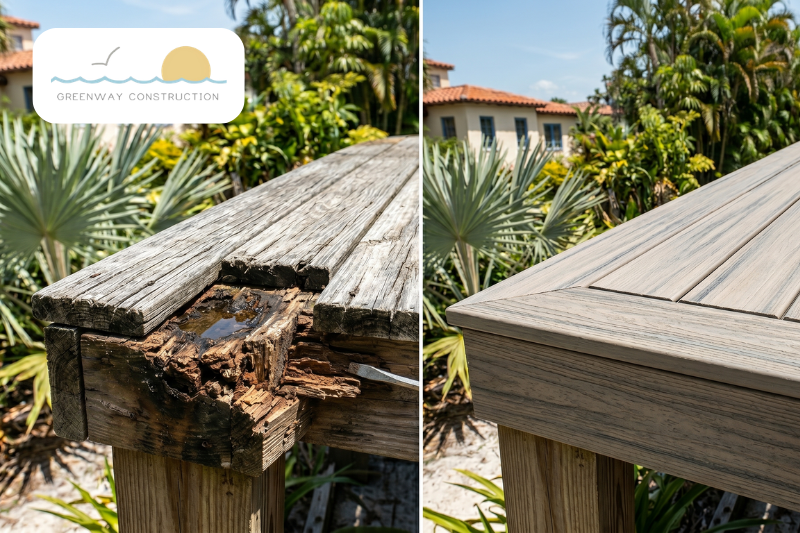
Key Takeaways: Making the Right Choice
- Durability: Composite decking (like Trex) is engineered to last 25–50 years in Florida, whereas pressure-treated lumber typically averages 10–15 years due to high humidity.
- Maintenance: Wood requires annual fading and sealing to prevent rot; composite only needs occasional soap-and-water cleaning.
- Heat Performance: Modern composite materials now feature “Cool Deck” technology to compete with wood’s natural ability to stay cooler under the Sunshine State sun.
- Cost vs. Value: While wood is cheaper upfront, the ROI on composite is higher due to zero maintenance costs and a significantly longer lifespan.
If you are planning to build a deck in Florida, specifically in the unique environment of Pinellas County, the first and most critical decision you will make is the decking material. With our extreme humidity, salt air, and relentless UV rays, the choice between composite or wood isn’t just about aesthetics; it’s about longevity and your future weekends.
At Greenway Construction, we see firsthand how the Gulf Coast climate affects different plant materials and construction supplies. Before the decking is built, you need to understand how these materials perform under pressure.
At a Glance: Composite vs. Wood Comparison
| Feature | Pressure-Treated Wood | Trex Decking (Composite) |
| Initial Cost | Lower Upfront Investment | Higher Upfront Investment |
| Maintenance | Annual Staining/Sealing Required | Soap & Water Wash Only |
| Lifespan | 10–15 Years (Avg in FL) | 25–50 Years |
| Durability | Prone to Rot, Warping, Splinters | Resistant to Rot, Mold, Insects |
| UV Resistance | High Fading & Sun Damage | Fade & Stain Warranty |
| Heat Retention | Holds Moderate Heat | New “Cool Deck” Technologies |
The Pros and Cons of Wood Decking
Traditional pressure-treated lumber has been the standard for decades. It is affordable and offers that classic “real wood” feel. However, in cities like Largo or Clearwater, wood faces an uphill battle.
The main “pro” of wood is the lower initial cost. If you are on a tight budget, wood gets you an outdoor living space faster. The “cons,” however, are significant in Florida. Constant exposure to rain and heat causes wood to expand and contract, leading to damage like cupping and cracking.
To combat this, you must commit to a cycle of fading, staining, and fleeing and sealing every 12 to 24 months. If you forget to treat wood even for one season, the salt air can accelerate wood rot faster than you’d expect.
Why Many Homeowners Choose Composite Decking
Modern composite decking is engineered specifically to solve the problems wood creates. Brands like Trex decking use a blend of recycled wood fibers and plastic, capped with a high-performance shell.
When you choose composite decking, you are investing in high quality and peace of mind. Because the boards are non-porous, they don’t soak up the Florida humidity. This means no warping, no splinters for bare feet, and no rot.
While the time design and installation require a skilled deck builder familiar with thermal expansion, the long-term payoff is massive.
Most composite brands offer a 25-to-50-year warranty against fading and staining, ensuring your deck looks as good in year 10 as it did on day one.
The Real Cost Over Time
While wood is cheaper today, the maintenance costs add up. By the time you factor in the cost of high-end stains, pressure washing, and the eventual replacement of soft boards, a wood deck often becomes more expensive than composite within 7 to 9 years.
Contact Greenway Construction Today
If you want the best ROI and a maintenance-free lifestyle in Pinellas County, composite decking is the winner. However, if you prefer the natural look of wood and don’t mind the “weekend warrior” maintenance, pressure-treated lumber remains a viable, budget-friendly option.
Ready to start your project?
Our expert deck builders are here to help you navigate the time, design, and material selection.
Contact us today for a free quote, and let’s build a high-quality space you’ll love for decades.
Comments are closed